1.1. Tocharian and the Indo-European language family
Imagine discovering, among the manuscripts of a Buddhist monastery in Central Asia, a language whose closest historical relatives are spoken thousands of kilometres to the west and south. Its vocabulary contains words that recall Greek and Latin; its grammatical endings preserve distinctions familiar from Sanskrit; yet its sounds and patterns of word formation are, in many respects, quite unlike those of any of its better-known relatives. Such a discovery might seem improbable. How could a language spoken in the oases of the Tarim Basin possibly belong to the same family as the languages of ancient Greece, Rome, and Vedic India?
Tocharian belongs to the Indo-European language family, the same broad genealogical group that includes Greek, Latin, Sanskrit, Avestan, Gothic, Hittite, Old Irish, and many modern European and South Asian languages. Its geographical position is particularly remarkable. Whereas most of the languages traditionally studied in introductory Indo-European linguistics are associated with Europe, the Mediterranean, or the Indian subcontinent, Tocharian is attested considerably farther east, in what is now the Xinjiang region of north-western China.
It is important, however, not to confuse geographical proximity with linguistic relationship. Languages are classified according to their historical descent, not according to the locations in which they happen to be spoken. English and Persian, for instance, belong to the same linguistic family despite their considerable geographical separation; conversely, two neighbouring languages need not share a recent common ancestor. The geographical distribution of a language tells us where its speakers lived, but its grammar and sound system can tell us something about where it came from.
How, then, do linguists establish that two languages are related?
The answer lies in comparative linguistics. Languages do not become related merely because a handful of their words look similar. Similarity may arise through borrowing, coincidence, or independent developments. Instead, historical linguists look for systematic correspondences: recurring relationships between sounds, grammatical endings, patterns of word formation, and vocabulary. When the same relationships appear across a substantial body of material, they provide evidence that the languages descend from a common ancestor.
Consider the word for 'horse'. Tocharian B has yakwe, which is traditionally discussed alongside Latin equus and Sanskrit aśva-. These forms are not identical, and their relationship is not immediately obvious to someone encountering them for the first time. Indeed, if we compared only these three words, we would have very little basis for establishing a historical connection. What makes the comparison meaningful is the wider system of sound correspondences into which the forms fit.
The comparative method works rather like solving a historical puzzle. A linguist begins with the surviving pieces, identifies recurring patterns, and proposes an earlier form capable of explaining them. That earlier form is not directly heard or read; it is reconstructed from the evidence left behind by its descendants.
The reconstructed language from which the Indo-European branches ultimately descend is conventionally called Proto-Indo-European (PIE). It was not preserved in a manuscript, nor was it recorded by an ancient grammarian. It is a scholarly reconstruction, supported by the systematic comparison of its descendant languages.
Tocharian is particularly significant because its historical development does not fit comfortably into an overly simple division between European and Asian Indo-European languages. Its geographical location might tempt us to imagine that it represents an eastern extension of an otherwise familiar linguistic group. The actual picture is considerably more complicated. Tocharian displays numerous distinctive phonological and morphological developments, and its precise position within the Indo-European family has long attracted scholarly discussion.
This is one of the most rewarding aspects of studying the language: Tocharian does not simply confirm what we already know about Indo-European. It forces us to reconsider the history of the family as a whole.
1.2. Tocharian manuscripts
Tocharian would probably remain unknown to us had its manuscripts not survived in the dry climate of Central Asia. Unlike many regions where organic writing materials deteriorate rapidly, the arid conditions of the Tarim Basin helped preserve manuscripts that might otherwise have disappeared centuries ago.
The principal discoveries come from oasis settlements along the northern edge of the Tarim Basin, particularly those associated with Kucha, Qarašahr, and Turfan. These settlements were not isolated communities at the edge of the inhabited world. They formed part of a network of routes connecting China, Central Asia, India, and, ultimately, the Mediterranean. Merchants, pilgrims, monks, translators, and travellers passed through the region, carrying not only goods but also religious traditions, literary works, and languages.
The Tarim Basin therefore provides an unusually interesting setting for the study of linguistic contact. A manuscript written in Tocharian might preserve Indo-European grammatical structures, use a script derived from an Indian writing tradition, and contain Buddhist terminology transmitted through Sanskrit. These different elements are not contradictory. They reflect the cultural interactions that shaped the region.

The surviving material reveals two closely related languages conventionally called Tocharian A and Tocharian B. The names are modern scholarly designations, rather than necessarily the names by which their speakers identified their own languages.
Tocharian B is geographically more widespread in the surviving manuscript record, particularly around Kucha, whereas Tocharian A is more restricted and is especially associated with the eastern areas of the Tarim Basin. Their relationship is comparable, in broad terms, to that between two related historical languages that have developed separately over time: they share an inherited linguistic background, but they are not simply interchangeable varieties.
Tocharian B itself was not entirely uniform. Scholars distinguish three broad chronological varieties:
- Archaic Tocharian B, representing earlier linguistic material.
- Classical Tocharian B, the principal and most extensively represented literary variety.
- Late Tocharian B, reflecting later developments in the language.
These labels describe historical stages rather than three entirely separate languages. Nevertheless, the distinctions are important. A form found in an earlier manuscript need not look exactly like its counterpart in a later text. Pronunciation, spelling, morphology, and vocabulary can all change over time.
Consider how much the history of English complicates the reading of its own texts. The English of Beowulf is not simply modern English written with unfamiliar spelling. Its vocabulary, inflections, and grammatical structures belong to a different historical stage of the language. In the same way, a student reading Tocharian B must learn to distinguish genuine historical developments from scribal variation and editorial intervention.
The surviving corpus also reflects the circumstances in which Tocharian was written. Buddhist monasteries were important centres of literacy, education, translation, and manuscript production. Consequently, a substantial proportion of the texts concern religious doctrine, monastic discipline, Buddhist narrative, and philosophical instruction.
This does not mean that Tocharian B was exclusively a religious language. Medical texts, administrative documents, letters, caravan passes, and other secular materials also survive. Such documents are particularly valuable because they offer glimpses of ordinary activities that religious literature might otherwise leave unrecorded.
There is an important distinction between the language people spoke and the language that happens to survive in writing. Our knowledge of Tocharian is necessarily shaped by the interests of the people who produced its manuscripts. Buddhist literature is overrepresented not necessarily because everyone spent their lives discussing religious doctrine, but because religious institutions were among the principal producers and preservers of written material.
The manuscripts are therefore both linguistic evidence and historical artefacts. They tell us about the structure of a language, but also about the society in which that language was used.
1.3. The Brāhmī script
Before examining the sounds and grammar of Tocharian B, it is worth considering the writing system in which its manuscripts were recorded. After all, a language and its script are not the same thing. A language may be written in several different scripts, and a script may be adapted to represent several unrelated languages.
Tocharian B was generally written in a regional form of the Brāhmī script, a writing system originating in the Indian subcontinent and widely used across South and Central Asia.
Brāhmī is not an alphabet in quite the same sense as the Latin script. It is an abugida, a system in which consonant signs ordinarily carry an inherent vowel. Additional signs can modify that vowel, while a special mark can suppress it.
This means that a Brāhmī consonant character does not normally represent a consonant in isolation. Rather, it represents a consonant together with an associated vowel unless some additional sign indicates otherwise.
The distinction is easier to understand if we compare an alphabet with an abugida.
In the Latin alphabet, the sequence ka consists of two separate letters: k and a. Each has its own independent character. In an abugida, the consonant character itself normally represents something like ka, and a separate vowel sign changes the inherent vowel when necessary.
This is not merely a typographical difference. It affects how a reader analyses written forms and how a writing system represents the sound structure of a language.
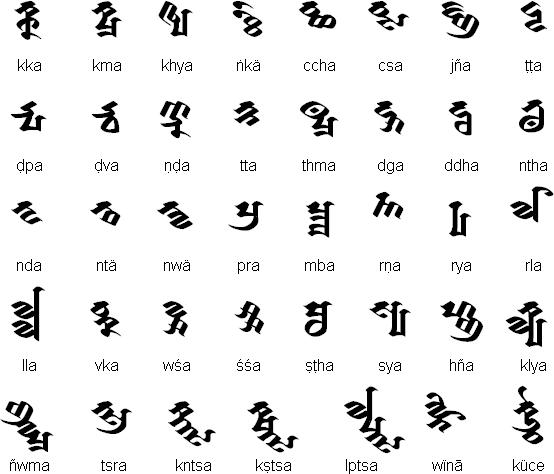
The Sanskrit-oriented Brāhmī writing tradition was not perfectly suited to representing every sound of Tocharian. As a result, the script was adapted. Additional signs and modified conventions were used to represent sounds that were not adequately covered by the ordinary Sanskrit inventory, including the vowel conventionally transcribed as ä and certain Tocharian consonantal distinctions.
The relationship between script and pronunciation must therefore be treated carefully. A written character is not automatically a transparent representation of a sound. It belongs to a particular writing tradition, with conventions that may have developed for another language before being adapted to Tocharian.
This brings us to an important distinction in the study of ancient languages: transliteration and transcription.
A transliteration attempts to represent the written characters of a manuscript in another writing system. Its principal concern is the relationship between signs. A transcription, by contrast, attempts to represent the linguistic form that the editor understands those signs to express. Its concern is pronunciation and linguistic interpretation.
The distinction becomes especially important when manuscripts are damaged. A word may survive only partially, and an editor may restore missing material on the basis of grammar, context, or comparison with other forms.
Modern Tocharian editions use editorial conventions to make such interventions visible. Parentheses, brackets, and other marks may indicate restored or uncertain material, depending on the conventions of the particular edition.
These marks should never be dismissed as decorative punctuation. They tell the reader something about the quality of the evidence.
A form printed without qualification may be clearly preserved in the manuscript, whereas a partly restored form involves an element of scholarly interpretation. The distinction between what the manuscript actually contains and what the editor believes it must have contained is fundamental to responsible historical analysis.
For a beginner, the most practical approach is to become comfortable with the conventional Roman transcription before attempting to read the original Brāhmī characters. Once the transcription system is familiar, the underlying phonology and morphology become much easier to analyse.
1.4. The phonological inventory: the sounds of Tocharian B
Having established how Tocharian B was written, we can now turn to the sounds represented by its writing system.
Phonology is the study of the sound system of a language. It is concerned not simply with how individual sounds are pronounced, but with the distinctions a language makes between them, the environments in which they occur, and the historical processes through which they develop.
This last point is particularly important in Tocharian B. Its sound system is not an arbitrary collection of unfamiliar symbols. Many of its features are the results of historical developments that can be traced through comparison with earlier stages of the language.
The consonant inventory includes the following representative sounds:
| Category | Representative sounds |
|---|---|
| Stops | p, t, k |
| Affricate | ts |
| Fricatives | s, ṣ, ś |
| Nasals | m, n, ñ |
| Lateral | ly |
| Rhotic | r |
| Glides | w, y |
The inventory is presented here in a simplified introductory form. The precise phonetic interpretation of certain sounds, and the extent to which particular contrasts were maintained in every period and environment, require more detailed discussion.
Nevertheless, several symbols deserve particular attention.
The sequence ts represents an affricate: a consonant beginning with a complete closure in the vocal tract and releasing into friction. A familiar English example occurs at the end of cats.
The symbol ly represents a palatal lateral. A lateral consonant is produced by allowing air to pass around the sides of the tongue, while palatal articulation involves raising the body of the tongue towards the hard palate. The consonant is therefore not simply an ordinary l, but a more specialised articulation.
The symbol ñ represents a palatal nasal, comparable in broad articulatory terms to the sound represented by ñ in Spanish señor.
The glide w is broadly comparable to English w, while y represents a palatal glide comparable to the initial sound in English yes.
One should not assume, however, that familiar English examples reproduce the exact pronunciation of the Tocharian sounds. They are useful approximations, not recordings of ancient speech.
Another important feature is the distinction between single and geminate consonants.
A geminate is a consonant that is phonetically longer than its singleton counterpart. In other words, the difference is one of duration. A single consonant is relatively short, whereas a geminate is held for longer.
This distinction occurs in a number of languages. Italian, for example, distinguishes forms such as pala and palla, where the length of the consonant contributes to the difference in pronunciation and meaning.
In Tocharian B, gemination is likewise an important feature of the phonological system. It should not be confused with accidental doubling in manuscript spelling. A doubled consonant in a scholarly transcription may represent a genuine phonological distinction, although the interpretation of manuscript spellings must always take account of the writing conventions employed.
Why should a student of Tocharian care about consonant length?
Because phonological distinctions can become grammatical distinctions. A consonant may change its form when a noun is placed into a different case or number, or when an ending is attached to a stem. If the student ignores consonant length and quality, forms that belong to the same paradigm may appear unrelated.
The sound system is therefore not something to be learned separately and then forgotten. It is one of the foundations of Tocharian morphology.
1.5. Palatalization: when sounds influence one another
Of the various sound changes encountered in Tocharian B, palatalization is among the most important.
Palatalization occurs when a consonant acquires a palatal or more palatalised articulation. It frequently arises under the influence of a neighbouring front vowel or glide, because the tongue is already moving towards the hard palate in order to produce the neighbouring sound.
The process is hardly unique to Tocharian. It occurs across a wide range of languages and has played an important role in the historical development of Indo-European phonology.
Consider, for example, the different historical treatments of velar consonants in Indo-European languages. In some branches, particular velars developed into palatal or affricate sounds under specific phonological conditions. In others, they remained velars or developed differently. Such differences are among the features that make the comparative study of Indo-European languages possible.
Tocharian B provides its own examples of the interaction between phonology and grammar.
One of the most interesting consequences of historical palatalization is that the original phonological environment may eventually disappear. A consonant that was once palatalized because of a neighbouring vowel may remain palatalized even after that vowel has changed or disappeared.
At that point, speakers no longer need the original environment to produce the sound. The distinction has effectively become part of the language's sound system.
This is particularly significant when examining noun paradigms.
Consider the following forms discussed by Weiss:
| Form | Meaning or grammatical information |
|---|---|
| trite | 'third', nominative singular |
| trici | 'third', nominative plural |
| lyak | 'thief', nominative singular |
| lysi | 'thieves', nominative plural |
| kertte | 'sword', nominative singular |
| kercci | 'swords', nominative plural |
At first glance, the alternations may seem irregular. Why does a consonant appear in one form but not in another? Why does the plural of a noun seem to involve a change to the stem itself?
The answer lies in the interaction between historical sound change and morphological structure.
The plural endings are associated with phonological environments that affected the consonants preceding them. Over time, these developments produced different stem shapes in the singular and plural forms.
The resulting relationship is not random. It is historically motivated.
This is an example of morphophonology, the study of the interaction between morphological structure and phonological processes.
A useful comparison can be made with English leaf and leaves. The plural is not formed simply by adding an ending to an unchanged stem. Instead, the final consonant changes from /f/ to /v/. Although the historical development is different from that of Tocharian, the analytical principle is similar: grammatical distinctions can be accompanied by changes in the sound structure of a word.
This is why it is so important to learn words as members of paradigms rather than as isolated dictionary entries.
A student who memorises only lyak may fail to recognise lysi as the plural of the same noun. A student who understands the historical relationship between the two forms can identify the underlying grammatical connection.
The larger lesson is that morphology cannot always be understood by examining endings alone. Sometimes the stem itself carries evidence of the grammatical distinction.
1.6. Syncope and epenthesis: the disappearance and appearance of sounds
Palatalization is not the only process that complicates the relationship between the historical structure of a word and its surviving form. Two other processes are particularly important when studying Tocharian B: syncope and epenthesis.
Syncope is the disappearance of a vowel within a word, usually an unstressed vowel.
Epenthesis is the insertion of a sound into a word, frequently a vowel.
Both processes are widespread in the world's languages. They often arise because speakers tend to favour certain sound sequences over others, and because sounds in unstressed positions may be more susceptible to weakening or disappearance.
To understand why these changes matter, imagine a hypothetical earlier form containing three syllables. Over time, an unstressed vowel in the middle of the word may weaken until it disappears. The result is a shorter word containing a consonant cluster that did not previously exist.
Conversely, a difficult consonant cluster may acquire an additional vowel, making the sequence easier to pronounce.
These changes can make the historical structure of a word difficult to recognise. A form preserved in a manuscript may look quite different from the form that comparative reconstruction suggests existed at an earlier stage.
The important point is that a written form is not a frozen representation of its earliest historical structure. It is the result of a series of developments.
We can distinguish several processes:
| Process | What happens? |
|---|---|
| Palatalization | A consonant develops a palatal articulation |
| Syncope | A vowel inside a word disappears |
| Epenthesis | A sound is inserted into a word |
| Assimilation | One sound becomes more like a neighbouring sound |
| Gemination | A consonant becomes or is realised as long |
Assimilation is worth mentioning alongside the others. It occurs when one sound becomes more similar to another, often because the two occur close together in speech. For instance, the place or manner of articulation of one consonant may be influenced by its neighbour.
These processes are not independent curiosities. They help explain why the same underlying morphological formation may produce different surface forms in different grammatical environments.
This is especially important when we turn to noun declensions and verb conjugations. The student must learn to recognise that an apparently missing vowel, an unexpected consonant, or a change in stem shape may be the result of a regular historical process.
The task of the historical linguist is not to dismiss such forms as irregular. It is to ask what sequence of developments could have produced them.
1.7. Historical phonology and the Indo-European comparison
The preceding sections have introduced several features of the Tocharian B sound system. We can now consider how these features fit into the wider study of Indo-European historical linguistics.
The central concern of historical phonology is the relationship between sounds at different stages of a language's development.
When linguists compare related languages, they are not merely collecting similar words. They are attempting to establish the sound changes that connect one historical form with another.
This requires distinguishing between three important levels of linguistic reconstruction:
- PIE: Proto-Indo-European.
- PT: Proto-Tocharian.
- PTB: Proto-Tocharian B.
- TB: attested Tocharian B.
An asterisk is conventionally placed before reconstructed forms to indicate that they are not directly attested. Thus, a form written with an asterisk is a scholarly reconstruction rather than a word copied from a surviving manuscript.
The distinction is fundamental.
Suppose we encounter a noun in a Tocharian B manuscript. We can observe its written form, identify its grammatical ending, compare it with related forms in other Tocharian texts, and examine possible cognates in other Indo-European languages. From these comparisons, we may reconstruct an earlier form.
The reconstruction is an explanation of the surviving evidence. It is not an independently documented historical fact.
It is also important to recognise that different stages of reconstruction answer different questions. A proposed Proto-Indo-European form attempts to explain the inherited material across the Indo-European family. A Proto-Tocharian form attempts to explain the developments shared by the Tocharian languages. A Proto-Tocharian B form belongs to the reconstructed history of that particular branch.
The relationship can be represented schematically:
Proto-Indo-European → Proto-Tocharian → Proto-Tocharian B → Attested Tocharian B
This is a very...simplified illustration rather than a complete account of the family tree. In particular, it does not imply that every change occurred in a neat, uninterrupted sequence, or that the relative chronology of all developments is known with certainty.
Indeed, one of the difficulties of historical linguistics is that sound changes do not necessarily occur simultaneously. A language may undergo several changes at different periods, and their effects can overlap. Some developments may precede the separation of related dialects, while others occur after communities have become linguistically distinct.
Tocharian B is especially valuable because its phonological and morphological developments provide evidence that cannot simply be inferred from Greek, Latin, Sanskrit, or the other better-known branches. It offers another perspective on the reconstruction of Proto-Indo-European and helps test hypotheses about the development of the family.
Historical linguistics is not the art of finding an ancient word that looks vaguely like a modern one. It is the disciplined reconstruction of relationships through repeated, independently supported correspondences. A convincing explanation must account for a substantial body of evidence, including forms that at first appear irregular or unexpected.
When Weiss discusses a Tocharian B form as developing from an earlier Proto-Indo-European or Proto-Tocharian formation, the explanation should be understood in this sense-- It is but an account of how the attested form may have developed through a series of historically motivated changes.